
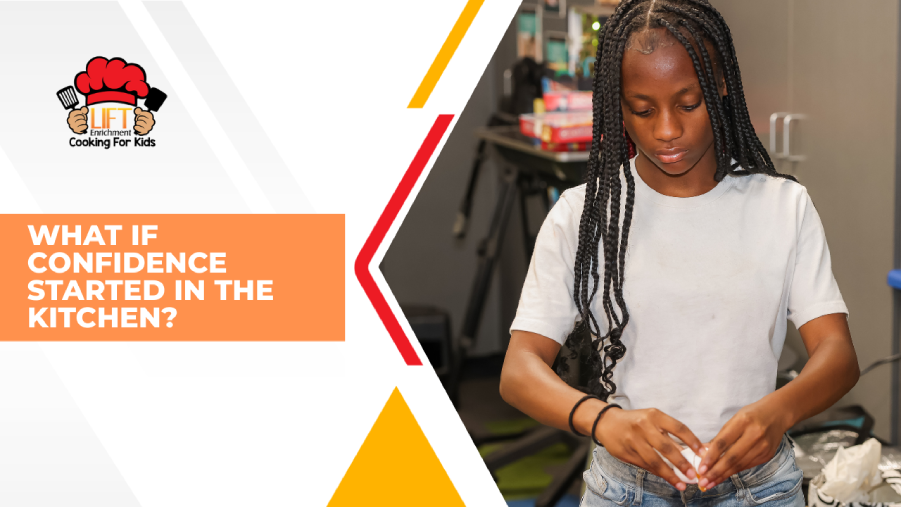
For 16 years, we have focused on one mission: helping students build lifelong skills through culinary education.
But underneath that mission is a quieter belief.
Confidence is not something you hand to a student. It is something they earn. And it usually starts with competence.
We often talk about wanting confident students.
Confident speakers.Confident learners.Confident leaders.
But confidence without competence is fragile.
The students who truly believe they can handle a challenge are usually the ones who have handled challenges before.
Not perfectly. But repeatedly.
That is where our afterschool culinary program fits in. Every session gives students a structured challenge:
Follow the recipe.
Manage your station.
Coordinate with your team.
Adjust when something does not go as planned.
When they complete that process, they do not just feel satisfied, and they know they can do it.
Mistakes Are Part of the Process
In the kitchen, something can go slightly wrong.
The heat is too high.The seasoning is off.The timing needs adjusting.
And that is the point. Students learn that mistakes are not failures. They are information.
Taste. Adjust. Try again.
That mindset quietly reshapes how they approach other areas of school. Confidence grows when students realize they can recover.
Responsibility Changes Behavior
When a chef instructor assigns roles, something shifts in the room.
This student is responsible for measuring.That student manages the skillet.Another monitor’s timing.
Responsibility creates focus. And when students see that their role affects the final outcome, they take ownership.
Ownership builds competence. Competence builds confidence.
Confidence Shows Up in Small Ways First
It does not always look dramatic.
Sometimes it is a student volunteering to plate the dish.Sometimes it is a student explaining a step to a peer.Sometimes it is a student asking to cook at home.
Families often tell us that after a few sessions, their student starts requesting ingredients or offering to prepare dinner.
That transfer of initiative is not accidental. It is the result of repeated, structured practice.
So Why Does This Matter Now?
Many educators are seeing increased stress and hesitation among students. While there is no single solution, one response is clear:
Students need opportunities to practice real responsibility in a safe environment.
Culinary education provides that.
Not through lectures but through action.
Confidence does not appear overnight.
It compounds.
One recipe.One role.One completed dish at a time.
If you are interested in bringing an afterschool culinary program to your school and want to learn how it fits within expanded learning and available funding, you can book a free call with our team using the link below.
Previous Newsletters:
How to Get Even the Pickiest Students to Try New Food, The almost magical benefits of “ordinary” family dinners, Behind the scenes of filming recipes from LIFT Enrichment’s cookbooks