
Why, really, do we send children to school? Is it, as Neil Postman might say, to invite children into the “Great Conversation” of human achievement since the dawn of time? Or to turn students into AI-assisted humanoids who’ll command the greatest dollar value in the modern economy?
It’s a tricky question. At LIFT Enrichment, we think one of the goals is simply to develop confident children. We aim to develop confident children who possess the skills necessary to thrive in the world beyond school. And that’s where teaching children to cook comes in.
Cooking builds confidence—not just self-esteem
“Self-esteem” is a phrase that gets thrown around a lot. “Children are lacking self-esteem,” people say, as if it were a nutritional supplement. The issue?
Self-esteem isn’t really based on anything. It’s a feeling. So inflating a child’s self-esteem can, ironically, lead to children with a brittle self-identity that cracks when it meets reality.
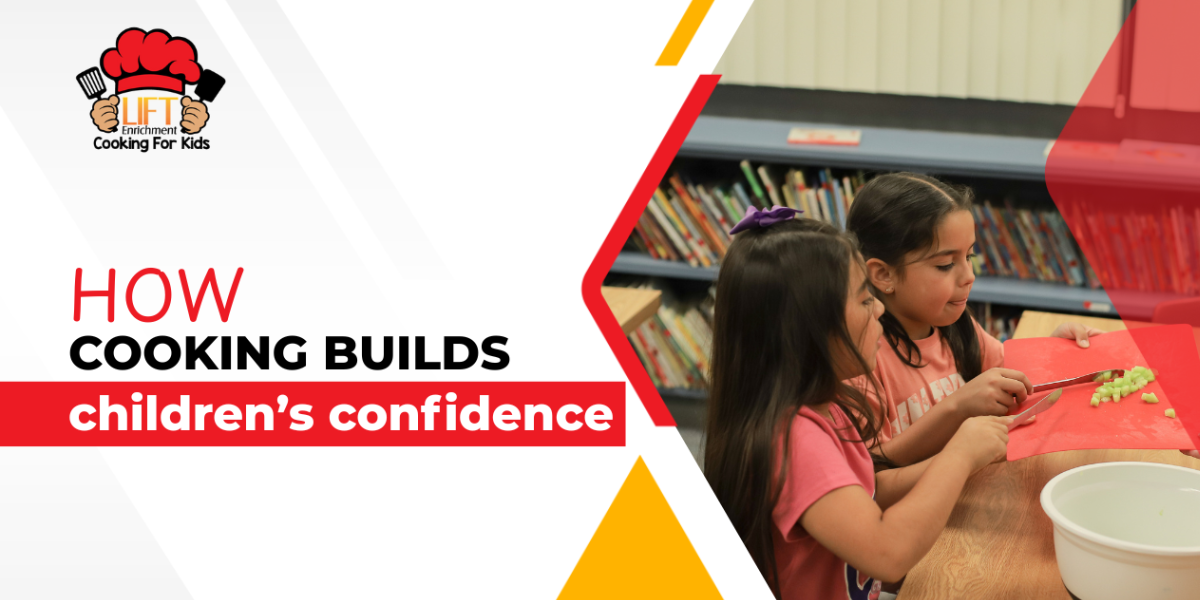
Confidence, on the other hand, is more grounded. It’s something children build by challenging themselves and learning skills. Cooking is a perfect example. At the start of our afterschool culinary program, children have almost zero culinary skills. But by the end of 5 semesters, they’ll have 60 recipes under their belt.
Do you think a child who can cook 60 meals will feel a bit more confident about themselves? We certainly think so.
Real skills beat virtual skills
“It’s no big deal that children play video games,” some people say. “Those games teach them skills!”
We agree. Games indeed do teach children skills. Just not ones that are actually useful in the real world. This, we believe, is why children who spend thousands of hours leveling up virtual characters have confidence issues. They might be able to thrive in Azeroth, but not in real life.
What’s great about cooking is it’s the ultimate real-world skill.
A child who can rustle up a meal, who knows how to fuel their body and which flavors go well together, who knows their way around a grocery store, and who can cook for friends and family? It is a child who can survive and thrive in the real world, which translates into a whole lot of confidence.
Social skills beat virtual skills too
Q: Who are the least confident students in school?
Usually, those who struggle to build relationships with peers.
And there’s a reason for that.
Socializing with others, like being able to feed yourself, is a key human skill. And a skill which, in today’s virtual childhoods, is becoming increasingly rare. The beauty of teaching children culinary skills is that, at heart, cooking is social. It might even be “THE” social skill, as humans have been cooking and eating together since the dawn of civilization.
A child who can cook for others and eat with others is going to have far better social skills, which, again, equals a lot more confidence.
Cooking is concrete
Tim Ferris is a fairly accomplished guy. He is the author of five New York Times bestsellers, the host of a podcast with a billion downloads, a successful entrepreneur, and a highly skilled tango dancer.
And yet, do you know what he said was the most satisfying thing he’s ever done?
Building a shed in his backyard.
Let that sink in.
The greatest achievement of one of the planet’s greatest achievers is building his own shed.
As to why that might be, it’s pretty simple:
Building a shed, or making anything with your hands, is concrete. You can see it, touch it, and, in the case of cooking food, eat the fruits of your labor too. This is why children who learn culinary skills become more confident. There’s a confidence that comes from building and making things that’s much harder to get by manipulating 1s and 0s on a screen.
The Cure for the Anxious Generation?
Jonathan Haidt, psychologist and author, calls the generation of children raised on screens “The Anxious Generation.” Having lived a lot of their life in virtual worlds, they’ve never built the confidence that comes from interacting with the real one.
The cure for an anxious generation isn’t complicated, though. Just get children cooking in the kitchen.
And if you’d like to help your students take that step, you might be interested in bringing a LIFT Enrichment afterschool culinary program to your school. If so, and you’re wondering how that would work, as well as about the government grants available to fund it, you can book a free call with one of our team by clicking the link below:
Previous Newsletters:
The almost magical benefits of “ordinary” family dinners, Behind the scenes of filming recipes from LIFT Enrichment’s cookbooks, LIFT Enrichment and New York schools are teaching hundreds of children how to cook